



AI & Data Science for Medicine

Habib LatifizadehMachine learning · Causal inference · Computational biology

Trustworthy AI and rigorous statistical modeling for multimodal biomedical and physiologic data — built for translational clinical impact.

I develop machine-learning, causal-inference, and multi-scale modeling methods that turn complex clinical, physiologic, and molecular data into reliable, uncertainty-aware evidence for medical decision-making. My work sits at the interface of data science, biomedicine, and computational biology.

NowProject Co-Investigator & Visiting Scholar, MIT Laboratory for Computational Physiology (MIT Critical Data) — 2026–2027
2024–2026Postdoctoral Associate, Department of Biostatistics & Bioinformatics, Duke University
FundedNamed Personnel, NIH/NIAID R01 AI173333 — Duke–Weill Cornell translational immunology project
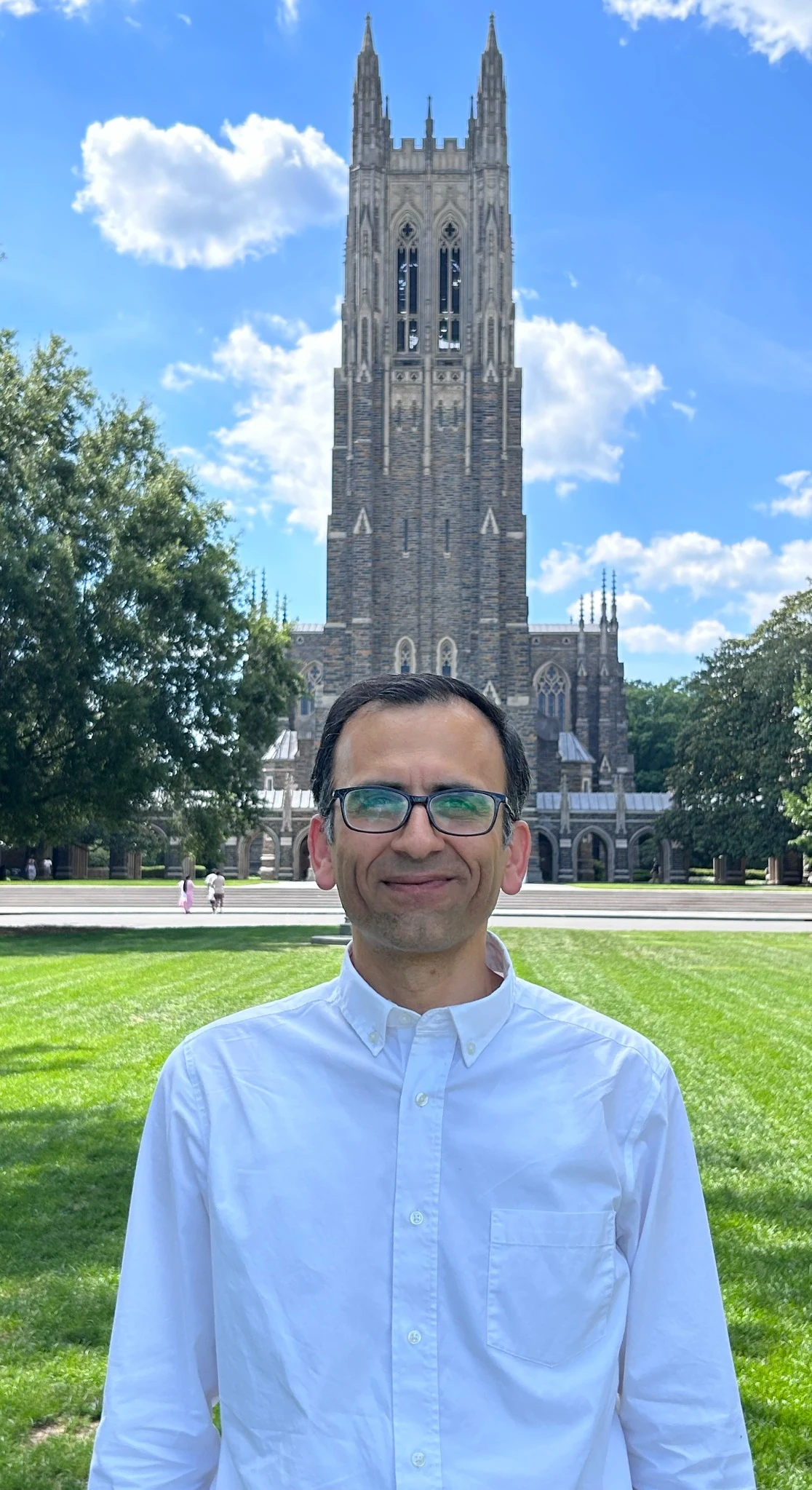
Habib Latifizadeh in front of Duke Chapel, Durham, NC.

Research Bio

Clinical AI is accurate on average and unreliable at the edges that matter — the individual patients, subgroups, and physiologic moments where decisions are hardest. My work pairs causal reasoning, mechanism, and calibrated uncertainty so models are honest about what they don't know.

As Project Co-Investigator and Visiting Scholar at the MIT Laboratory for Computational Physiology (MIT Critical Data), I lead reliability and harm evaluation of multimodal clinical AI across imaging and electronic health records. My work sits at the interface of machine learning, causal inference, computational biology, and translational clinical research — turning high-dimensional biomedical, physiologic, and molecular data into reliable, uncertainty-aware evidence, spanning causal Bayesian networks, generative modeling, optimal transport, physics-informed neural networks, and multi-scale mechanistic modeling.

As a Postdoctoral Associate in the Department of Biostatistics & Bioinformatics at Duke University, I contribute to an NIH-funded Duke–Weill Cornell Medicine project (NIH/NIAID R01 AI173333, Permar Lab) on immune correlates of protection, building multi-scale mechanistic and statistical-learning models. I hold a Ph.D. in Applied Mathematics & Data Science.

This trajectory — from a causal-network dissertation and deep-learning work in computational biology at WVU, through an NSF Digital Health fellowship, to multi-scale modeling at Duke and clinical-AI reliability at MIT — is a deliberately interdisciplinary one, aimed at the collaborative space between medicine, statistics, engineering, and the computational sciences. Across it I emphasize reproducible pipelines and explicit uncertainty quantification as part of the modeling task, not afterthoughts.

Research Vision

How do we build AI for medicine that clinicians and scientists can trust — because it respects the underlying biology and physiology, and reports what it does not know?

My independent program pairs mechanism-informed modeling, causal reasoning, and calibrated uncertainty across three directions spanning physiologic, clinical, and molecular data — each grounded in completed methodological work and sized for independent extramural funding (NIGMS, NHLBI, NIBIB, NICHD).

Research

Mechanism-informed, uncertainty-aware AI for biomedical and clinical data.

A single question organizes the program: how do we build models for clinical and biomedical decisions that are accurate at the edges that matter most — and that report what they do not know? The work spans four themes with a shared core in causal reasoning, mechanism, and calibrated uncertainty.

Explore the full research program →

Research Experience

Research trajectory across scientific problems and data modalities.

Full technical dossiers — MIT · Duke · NSF · PhD →

Selected Publications

Current-field work in causal inference, biological data science & scientific ML.

Explore more →

Ongoing Projects

Current research & collaborations.

Active · 2026–2027

Reliability & Harm Evaluation of Multimodal Clinical AI

At the MIT Laboratory for Computational Physiology, evaluating ensembles of deep-learning diagnostic-imaging models via a consensus-based harm score, and linking image-level error to ICU care phenotypes across MIMIC-IV and MIMIC-CXR with calibration, uncertainty quantification, and subgroup/fairness auditing.

Host: MIT Critical Data  ·  Role: Project Co-Investigator and Visiting Scholar
Research experience →
Active · 2026–2027

Surgical Decision Support for Epilepsy Outcomes

As Lead Data Scientist & Biostatistician at the Duke Comprehensive Epilepsy Center, leading the statistical design and reproducible analysis of a temporal-lobe-epilepsy study evaluating whether the SEEG-derived 5-SENSE focality score predicts postoperative seizure freedom — assessing discrimination, ROC/AUC with bootstrap CIs, calibration, and clinically meaningful thresholds across resection, LITT, and neuromodulation, with causal-explanatory subgroup and failure analysis.

Host: Duke Comprehensive Epilepsy Center · Dept. of Neurology  ·  Role: Lead Data Scientist & Biostatistician
Research experience →
Active · NIH-funded

Immune Correlates of Protection in Congenital CMV

Named Personnel on NIH/NIAID R01 AI173333, leading in-silico vaccine-efficacy modeling and maternal–fetal immune analytics through a multi-scale scientific machine-learning framework — a joint Duke–Weill Cornell Medicine collaboration.

Award: NIH/NIAID R01 AI173333  ·  PI: Sallie Permar (Weill Cornell)  ·  Duke Subaward PI: Cliburn Chan
NIH RePORTER →
In preparation

Cross-Species Cell-Type Mapping via Optimal Transport

Lead author on a methods manuscript using relaxed-marginal probabilistic optimal transport for reproducible cross-species alignment of flow-cytometry measurements — supporting standardized biomedical data integration and transferable out-of-sample inference.

Collaboration: Duke Center for Human Systems Immunology · Weill Cornell Medicine
Duke CHSI →
Preprint · arXiv

BaMANI — Causal Network Inference Toolkit

Combines constraint- and score-based structure learning with conditional-independence testing, multiple-hypothesis correction, and bootstrap stability.

Status: arXiv preprint (2025)  ·  Domain: Biomolecular & clinical relation inference
arXiv preprint →

Teaching & Mentorship

Methods as a craft — derivation, code, and a worked example.

I treat calibration, subgroup performance, and uncertainty as part of the modeling task itself, and design every course around a reproducible artifact students can rerun. Five graduate courses drawn from my research program, from statistical learning for health data to uncertainty-aware clinical ML.

Teaching philosophy, syllabi & mentoring →

Awards, Fellowships & Funding

Selected recognition & funding.

National Institutes of Health logo National Science Foundation logo
2025
Excellent Editor Award
IJMSSC · World Scientific
More →

Service & Academic Leadership

Editorial boards & peer review.

View full service profile →

Selected Talks

Invited & conference presentations.

2026

Cross-Species Immune-Cell Mapping via OT-RMC for CMV Vaccine Research

Invited Speaker · Duke CHSI / MISM Center of Excellence

2023

Data-Driven Modeling for Inferring Key Protein Impact on Cell-to-Cell Networks

Invited Speaker · BridgesDigital Health NRT, WVU

More Talks & Presentations →

Get in touch

Let's talk.

Open to collaboration, student inquiries, and academic recruiting conversations — especially with colleagues working in clinical AI, computational physiology, causal inference, and computational immunology.